Thursday, 31 March 2016

Hamas tunnelling again in Gaza as Israelis fear attack from below

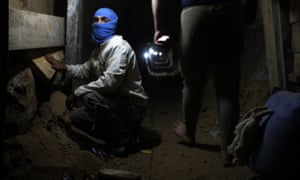
A Palestinian youth works inside a smuggling tunnel beneath the Egyptian-Gaza border in 2013. Most of these tunnels have since been destroyed by the Egyptian army.

The scraping, scratching, grating sound could be an insect in the wall, a rodent under the floorboards, or the creaking of water pipes. Or it could be Hamas operatives digging under the earth from Gaza to Israel.
Some residents of the small communities along the Israeli side of the Gaza border believe they can hear the faint sound of tunnelling in the dead of night. Others are sceptical, saying fear and paranoia are fuelling imaginations.
But there is no doubt that, 19 months after the end of the last war between Israel and Gaza, in which the discovery of Hamas’s tunnels was declared a casus belli by Israel, large-scale digging has resumed.
Ismail Haniyeh, the Hamas leader in Gaza, has said so. This year he told the people of Gaza that Hamas fighters were “digging twice as much as the number of tunnels dug in Vietnam”.

Iranian group gets help from Islam to save juveniles from execution

On the night of 22 March 2009, 17-year-old Hamid was in his dad’s mini-bus when their neighbour’s son, Ayyoub, 16, got in. Hamid was in the business of selling mobile phones, and Ayyoub had been in dispute with him for days over a cellphone he’d bought from him. As their argument became heated, Hamid grabbed part of a seat cover and strangled Ayyoub.
Hamid was sentenced to death by hanging. Murder in Iran carries capital punishment even for minors who are incarcerated until the sentence is carried out when they turn 18. The execution can be halted only if the victim’s family pardons the offender, usually in return for blood money.
Ayyoub’s father, Ali Kouravand, considered a pardon but this was in Izeh, a city in the south-western province of Khuzestan with strong tribal networks. As Hamid and Ayyoub were from different tribes, the father could not decide on his own. His tribe set stringent conditions for a pardon. They demanded that the killer’s family pay the victim’s a large sum, and then to leave Izeh.
It took the NGO Imam Ali’s Popular Students Relief Society much negotiation before Ayyoub’s family agreed to a pardon. In December 2015 Kouravand took his family to Ahvaz prison to meet his son’s killer – knowing that by pardoning Hamid, his family would be boycotted by their tribe, at least for a while.
Hamid had been prepared by Farzad Hosseini from Imam Ali Society. “His mind was frozen, he didn’t know how to react,” says Hosseini. “Before he entered the room where Ayyoub’s family were waiting, I told him: ‘Kiss their hands and apologise. Keep your head down’.”
Hamid did as he was asked. He bowed and kissed Kouravand’s hand, and in response Kouravand kissed his cheek, pardoned him and gave him his blessing. The family received around $35,000 in blood money, partly gathered by Imam Ali society through public fundraising.
Imam Ali’s Popular Students Relief Society was founded in 1999 by a group of students at Tehran’s Sharif University of Technology led by Sharmin Meymandi-Nejad, originally to combat poverty. Today 15,000 volunteers are involved in projects to help the vulnerable in twelve provinces including Tehran, Fars, Isfahan, Kermanshah, Hormozgan and Qom.
A playwright and university teacher, Meymandi-Nejad had been intrigued in 1997 by the case of Gholam Reza Khoshrou, known as khoffash-e shab (the night bat), who was tried and executed for the murder of nine women, some of whom he had raped. Meymandi-Nejad followed the story of Khoshrou in prison with the aim of making a documentary but was struck by the hardships Khoshrou had faced as a child, growing up with a step-mother in a poor and violent neighbourhood before being sent to a juvenile detention centre and at 18 to prison, where, he told his phycologist, he was raped many times by other prisoners. When Khoshrou was executed, Meymandi-Nejad promised himself he would do his best to help kids in violent neighbourhoods to keep them from becoming another Khoshrou. This led by 2006 to Meymandi-Nejad’s decision to work against the execution of juvenile offenders.
Since then the group has saved 25 juvenile offenders - including one woman - from execution and are working on nearly 50 other cases. Where offenders’ families cannot afford the blood money, the group raises funds from the public through conferences and online campaigning.
Cases usually come to their attention when juvenile offenders’ families seek their help, as Imam Ali Society lacks access to court files. “We face lots of restrictions, there is no systematic support,” says Hosseini, 33, who became involved eight years ago when a civil engineering student at Sharif University. “We can’t even visit our clients in prison easily. It depends on the prison staff who sometimes out of humanity let us pay limited visits to the offenders.”
After gathering information by reading official documents, talking to the offender’s family, and if possible visiting the offender in prison, comes what Hosseini describes as the “very difficult and complicated” task of approaching the victim’s family to seek a pardon.
By the time the Imam Ali Society is involved, the case is usually a few years old, which as Hosseini says, means the victim’s family anger and desire for revenge have had time to fester. The visit is often far from smooth.
Hosseini says he and fellow volunteers were attacked by one family of a murder victim: “They wanted to kill us.” But over time they were not only able to talk to the family but even convince them to share a meal with the offender’s family. “Everything depends on how we treat the [victim’s] family,” he says. “When we approach the next of kin, we see them as our own family. We put ourselves in their shoes. To us, the person who was killed is like our own brother or father.”
Hosseini carries with him a photograph of a father of seven killed ten years ago by a 17-year-old male, forgiven by the victim’s family last autumn. “I really love him like my own father.”
But however time-consuming the process can be, most cases are not successful. Hosseini says only one or two out of 100 see the victim’s family pardoning the juvenile offender. He cites the case of Alireza Shahi, hanged in November 2015 in Rajaei Shahr prison in Karaj city, west of Tehran, seven years after he killed someone during a street fight when he was 18.
“We tried so hard to convince the victim’s family, but they didn’t want to listen at all,” recalls Hosseini. “Even the night before the execution, we went to the prison and were next to his [Shahi’s] family until dawn. We were hoping that maybe the execution would be halted, but in the morning he was executed. I visited Alireza in prison twice. I hugged him. He was like my own brother. He was so innocent. It all had happened during a fight. I really can’t understand - why should this kid be executed?”
The UN Convention on the Rights of the Child says no death sentences should be imposed for offences committed by individuals under 18. Iran ratified the convention in July 1994, but the age of adult criminal responsibility remains nine lunar years for girls and 15 lunar years for boys.
While Imam Ali Society’s ultimate goal is to change the law and stop all executions of juvenile offenders, it has welcomed more limited changes. In May 2013 a new Islamic Penal Code was adopted, with Article 91 allowing a judge to impose an alternative punishment if there is doubt over the offender’s maturity and wisdom, or if the judge determines the juvenile did not comprehend the nature of the crime or its consequences. In December 2014, the general board of the supreme court ruled that all juvenile offenders on death row were entitled to request a retrial based on Article 91.
But these changes didn’t bring actual results. Hosseini says since 2013 they have encountered two or three cases positively affected by Article 91. Amnesty International reported 12 executions of juvenile offenders in 2014 and four in 2015: there had been four in 2012 and nine in 2013.
Iran doesn’t deny it executes juvenile offenders but often disagrees with numbers reported. The authorities also argue they are trying to make changes. In Januaryin a meeting with the UN’s Committee on the Rights of the Child in Geneva, Mahmoud Abbasi, deputy for human rights and international affairs at the justice ministry, said that reforming policies would not work without changing the attitudes “particularly of policy-makers and those directly involved with children”.
Neither the UN nor Iranian activists are prepared to ease up. On 14 March, during the 31st session of the UN Human Rights Council in Geneva, the UN special rapporteur on Iran Ahmed Shaheed said that “at least 73 juvenile offenders were reportedly executed” in Iran between 2005 and 2015. He added that “at least 160” others are on death row.
Three representatives from Imam Ali Society, including Hosseini, were present during the session. On 14 March, in response to Shaheed’s report, a representative read a statement noting the lack of implementation in many cases of Article 91 and restating opposition to executing those who committed the offence when aged under 18.
Hosseini says change should come primarily from below. “We believe that most of our social and human rights issues are solvable if we empower civil society within the country,” he explains. “When we started working years back, public mentality was different. People didn’t want to get close to imprisoned kids. But now through our efforts people are willing to help juvenile offenders, even murderers. Currently several thousand people [in Iran] are in favour of the abolition of death penalty for juvenile offenders, so now the judiciary and those in charge have realised these laws need to be changed.”
From Brighton to the battlefield: how four young Britons were drawn to jihad

The play was called Don’t Judge Me, a satire that poked fun at tabloid stereotypes of British Muslims. It was written, directed and produced by a 15-year-old from Brighton named Amer Deghayes, who had taken inspiration from some of the less considered headlines of the Daily Mail and the Sun. “They were so ludicrous they made me laugh,” he told one of the adults who helped with the production. “The way they called young people feral, wow!” The play, which was set to a rap soundtrack performed by Amer’s own group, Blak n’ Deka, toured theatres on the south coast in 2010, winning awards and plenty of plaudits.
Amer, who had his sights set on becoming a serious journalist, was the eldest son in his family. Two of his brothers were twins, Abdulrahman and Abdullah, a year younger and both keen footballers. Next was Jaffar, a studious, slight 13-year-old who had always wanted to become a fireman. The brothers bonded through kickabouts in their local park and swimming, running across shingle beaches headfirst into the English Channel. On Facebook, pictures show a grinning Amer pretending to swallow a starfish beside Brighton pier.
When he wasn’t spending time with his family, Amer hung out with his best friend, Ibrahim Kamara, a refugee from Sierra Leone. They did everything together, often writing rap tracks and politicised film scripts. Their last joint project was to have been a documentary exploring the insecurities of adolescence, titled Me, Myself & Before. In a fundraising pitch from November 2012, Amer and Ibrahim wrote: “It is a time in life when we are uncertain of the future, when some feel different, isolated and lonely. Teenagers are often confused and feel like outcasts.”
Their request for funds was made by Cultures Club, a Brighton youth arts organisation, and approved by the Heritage Lottery Fund. But by the time the funding was confirmed in the summer of 2013, it was too late – Cultures Club had lost all contact with Ibrahim and Amer.
In fact, in October 2013, Amer left Brighton for Syria, where he joined a radical Islamist militia fighting Bashar al-Assad’s army. Ibrahim soon joined him, along with two of Amer’s younger brothers, Jaffar and Abdullah. Two years later, only Amer is still alive.The young men left behind a large group of friends in Brighton, many of whom also appear to have been radicalised. Among them, police identified at least 20 people they deemed likely to travel to Syria; most of them were under 18, and at least half were converts from non‑Muslim backgrounds. Together, these teenagers so alarmed the authorities that Brighton’s senior police officers and council chiefs held secret meetings in early 2014 to discuss the possibility of a terror attack from its residents – and the seaside city was placed on the register of areas requiring extra support under the government’s counter-extremism strategy.
The question of what motivates young British men and women to leave their homes and join jihadist groups fighting in Syria has been the subject of heated public debate. The prevailing orthodoxy cites Islamist ideology as the principal driver – and it is obviously a necessary element, if not always the predominant motivation. What has been less understood is the process by which young people grow alienated with their own country, and seek the validation of their identity in a faraway civil war.

Wednesday, 30 March 2016

Passengers using Dubai airports to pay new tax

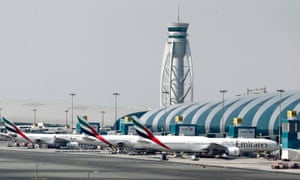
Dubai international airport, which handled more than 78 million passengers in 2015

The emirate of Dubai, whose airport is the world’s busiest for international passengers, has announced a new tax on travellers to help finance expansion, as Gulf governments grapple with plummeting revenues. The 35-dirham ($9.50) fee will apply to all passengers – including those passing through Dubai in transit – on all flights from 30 June, according to a statement carried by WAM state news agency.
It is the first time Dubai has announced a passenger tax, which is imposed in many airports worldwide.
More than 78 million passengers passed through Dubai international airport in 2015, keeping its place as the world’s busiest for international passengers since overtaking London Heathrow in 2014.
In February, Dubai Airports increased the capacity of its main airport to 90 million passengers with the opening of concourse D, at a cost of $1.2bn.
Dubai has a smaller second airport, Al-Maktoum International, which opened in 2013 and will receive 120 million passengers a year once completed.
The receipts of the new tax will be channelled into funding the expansion of Dubai airports, the statement said.
Although part of the oil-rich United Arab Emirates, Dubai has dwindling oil wealth, and its revenues are diversified compared with its oil-dependent Gulf peers.
But the whole region is struggling to cope with a sharp drop in oil revenues since crude prices nosedived.
Situated on transcontinental air routes, Dubai is one of several Gulf-based airports to experience prodigious growth in recent years.
About 100 airlines fly to more than 240 destinations from the international hub, which is also home to carrier Emirates.

Chief of Libya's new UN-backed government arrives in Tripoli

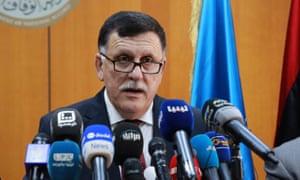
Fayez Sarraj speaks at a press conference

The chief of Libya’s new UN-backed government has reached Tripoli, defying threats from city militias, to proclaim a new order for the conflict-ravaged country in a move that could eventually pave the way for international forces to provide troops and air support.
Since Libya’s airspace had been closed by the existing Tripoli-based authorities, the prime minister designate, Fayez Sarraj, and seven members of the presidential council travelled from Tunisia by sea to the city’s Abusita naval base.
Sarraj is expected to call for outside help to train a new Libyan army and launch airstrikes against Islamic State bases in the country.
Sarraj told Reuters the council members had travelled in a Libyan navy vessel from the Tunisian port of Sfax, 12 hours away.
“There are challenges ahead of us, including uniting Libyans and healing divisions,” he said after arriving. He later made a brief statement saying the government would release a programme in the coming days.
“We will work for a ceasefire across Libya, for national reconciliation and the return of displaced people, and we will seek to confront Islamic State,” he said.
Western powers have recognised Sarraj’s government of national accord as Libya’s only legitimate government, but it faces opposition from both of the country’s existing regimes – the Tripoli-based General National Congress (GNC) and the elected House of Representatives in eastern Libya – and Sarraj may flounder without western support.

Footage emerges of hijacker and British passenger posing for photograph

Footage has emerged of the moment a British passenger casually strolled up the aisle of a hijacked EgyptAir plane and posed for the photograph with the man holding up the flight with what, at the time, was believed to be a suicide belt.
In the clip, filmed by a Dutch passenger, a steward can be heard asking the Briton, Ben Innes, to come up the aisle, adding: “You want to take a photo with him?”
Innes replies “yeah, yeah ... is that OK?” before walking up and standing beside the hijacker, Seif Eldin Mustafa, as well as two stewards.
As the two men pose beside each other, the photo is taken, before the steward asks: “Another one?” The phone is then handed back to Innes, who appears to express satisfaction after examining the shot. Other passengers giggle as they look up the aisle.

‘I feel like I’m in prison’: Qatar’s abuse of World Cup 2022 workers

Migrant workers building Qatar’s Khalifa International Stadium in Doha for the 2022 World Cup are suffering systematic abuse from their employers, says Amnesty International. The human rights organisation says that Fifa need to take action to prevent abuses from taking place. The Qatari Supreme Committee for Delivery and Legacy says it has ensured minimum working standards are met for World Cup stadium projects