Barack Obama’s announcement on Friday that American special forces will take a more active role in the war in Syria is for many critics of his foreign policy a confirmation that the US has inched deeper into a chaotic conflict.
It’s also an opportunity for presidential candidates to both praise
and denounce him. And most Republican and Democrat presidential
candidates propose doing even more than the raids that Obama has authorized,
which skeptics call “mission creep”. The war pits the Syrian president,
Bashar al-Assad, against various rebels and the jihadi group Islamic
State, and now involves the US, Russia, Iran, Gulf states, Turkey, the
Kurds and Iraq. Here’s how foreign policy might look under the ideas of
potential presidents.
No-fly zone
Nearly all the candidates of both parties have called for a no-fly
zone over Syria, arguing that denying Assad’s air force will better
protect civilians and rebels from bombing runs.
“A superpower can impose a no-fly zone if it decides it wants to,”
said Stephen Biddle, a professor of international affairs at George
Washington University. “But the problems are it’s very expensive, no one
is willing to pay the price, and these days there are serious risks of
escalation.”
A no-fly zone would require far more airstrikes on airfields and
anti-aircraft batteries, for instance, putting American pilots in danger
against Syrian missiles and jets. Russia’s entry into the war further
complicates the proposal, increasing the risk of shooting down Russian
aircraft bombing rebels.
And while a future president could warn Vladimir Putin to fly strikes
at his own peril, the US stands to lose more should Putin simply
continue strikes. An American president’s choice would then be to stand
down or risk a wider, far more dangerous war – and political disaster at
home – by firing on Russian pilots.
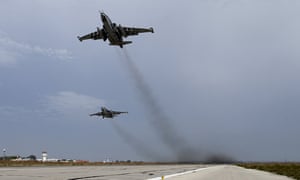
Russian Sukhoi Su-25 fighter jets take off from the Hmeymim air base
near Latakia, Syria, on 22 October. Photograph: Handout/Reuters
Nor would a no-fly zone offer certain protection to civilians or
rebels whom an American president finds acceptable. Most of the war’s
dead – civilian or combatant – have not been killed from the air but on the ground, by bullets, mortars and artillery shells, according to the Violations Documentation Center.
The statistics suggest a no-fly zone would not do much to staunch the
bleeding of civilians or any friendly rebels. In contrast, Russia’s
strategy of indiscriminate bombing boosts Assad’s much more limited
aims, which do not take civilian casualties into account.
Only Republican Rand Paul and Democrats Martin O’Malley and Bernie Sanders oppose a no-fly zone.
‘Safe zones’ and special forces
Billionaire Donald Trump
has maintained that “safe zones” on the ground in Syria and Iraq would
help end the war and solve the refugee crisis, and said that Turkey and
the Gulf states of Saudi Arabia, the UAE and Qatar should lead the
effort with US help.
But while a ground campaign could defend civilians from the deadliest
threats, it would also entail all the dangers of mission creep and the
painstaking logistics of a war effort. One American has already died in a raid on an Isis facility, and a Russian soldier died in Syria last week.
“To keep it safe would require fighting,” the defense secretary, Ash
Carter, told Congress on Tuesday. “You need to think in each case …
who’s in, who is kept out and how the enforcement of it is done.”
Any campaign would probably need snipers, radar and recon teams,
artillery and special operations teams – if not full infantry
battalions, Micah Zenko, a senior fellow at the Council of Foreign
Relations, has noted in Foreign Policy.
“The types of interventions that proponents have endorsed for Syria
are often based on deep misunderstandings of how US force was used on
behalf of humanitarian missions in the past,” Zenko wrote. “Proposals
that consciously ignore or downplay the amount and type of force needed
to protect civilians are just wishful thinking.”
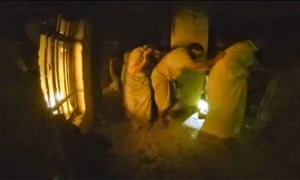
A still image taken from helmet camera video footage on 22 October shows
freed prisoners moving in line during a raid by US and Kurdish special
forces on a compound in northern Iraq. Photograph: Handout/Reuters
Biddle agreed, adding that another problem is that safe zones offer cover to both civilians and combatants.
“Say you set up a safe zone along the Turkish-Syrian border, and lo
and behold guerrillas start operating within it, and the government
starts firing artillery into it. What do you do then? Silence the
artillery by expanding your perimeter? Push the perimeter until it’s all
of Syria?”
He also noted the problem of policing, for instance the dilemma of a suspected rebel whose family vouches for their innocence.
“You don’t have to walk very far down the thought experiment to end
up with all sorts of problems and ambiguities,” Biddle said.
Senator Marco Rubio is the most vocal supporter of embedding special forces with rebel and Kurdish ground troops.
Arming rebels and Kurdish fighters
Most of the candidates support arms for rebels, though few have
specified which groups they find acceptable and how they would vet them –
the same problems that have slowed Pentagon efforts in the last two
years.
More problematically, most of the Syrian rebels eager for weapons and
aid are not interested in a concerted fight against Isis. “While there
are tens of thousands of rebels willing to receive training and
equipment to go after the Assad regime, few are willing to fight the
Islamic State,” Zenko wrote earlier this year.
Arming anti-Assad rebels may suit US interests, but it would also pit
the US against Russia and Iran in a proxy war. Even regional allies disagree with American priorities about Isis, Biddle noted, which is why Turkey continues to bomb Kurds and Saudi Arabia and the UAE arm groups around the region, most notably in Syria but also in the ruins of Yemen. These same conflicted interests make it unlikely that the nations would ever band together to form their own “safe zone”.
“They all have bigger fish to fry,” he said. “We’re the biggest, but
we’re the only one who thinks Isil is the threat to be resolved first.”
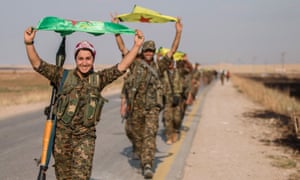
Kurdish fighters celebrate in Tel Abyad in the Raqqa governorate of
Syria after they said they took control of the area in June. Photograph:
Stringer/Reuters
Although Kurdish fighters have proven the most reliable allies for US ground offensives, Turkish warplanes have increased bombing sorties against Kurdish forces in Syria and Iraq, meaning increased arms for the Kurds could fuel a war between two American allies on yet another border.
Arming Kurdish fighters could also lead to the US supplying groups that it has named terrorists, if it hasn’t inadvertently done so already. In October Amnesty International accused the Kurdish group YPG of human rights violations.
Rubio, Jeb Bush and Lindsey Graham have spoken strongly in favor of
arming Syrian rebel groups and Kurds, Ted Cruz has called for directly
arming the Kurds, Hillary Clinton
urged arms for rebels and Kurds while she was secretary of state, and
even O’Malley has said the US should “probably” arm the fighters.
Troops in Afghanistan
All candidates except Senator Rand Paul have said they support Obama’s decision to extend the US military presence in Afghanistan to 2017, though a handful say they only do so out of deference to the generals’ advice.
But the presence of 5,500 to 10,000 troops, as the president and
candidates prescribe, would have little effect on the war against the
Taliban, experts said. Most said a steady run of airstrikes had
prevented the Taliban from massing, and that the end of “combat
operations” – resulting in a lull in airstrikes – had given the
militants opportunity to retake cities and regroup.
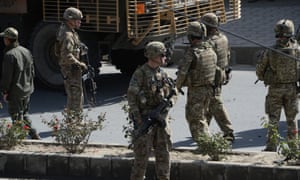
US soldiers arrive at the scene of a suicide car bomb attack on 11
October that targeted foreign military vehicles at Jo-e-Sher in Kabul,
Afghanistan. Photograph: Noorullah Shirzada/AFP/Getty Images
The spread of American troops at four airbases around Afghanistan and continued airstrikes – including one that bombed a hospital –
suggests Obama plans to let generals use as much airpower as possible
to support Afghan forces. But neither he nor any candidate has shown any
appetite for a major reinforcement.
Withdrawal
Barring dramatic changes to Barack Obama’s plans and the politics of
the Middle East, 2017 will begin with 5,500 troops across Afghanistan
and a number of special forces teams operating in Syria and Iraq.
Paul, Trump and Cruz have all offered variations on a plan that could
see US forces withdraw from the region, ceding a lead military role to
Russia and Iran but continuing airstrikes against Isis. But while
staying out of foreign conflicts has appeal at home to Democrats and Republicans
alike – and arguably supports US interests – “it still sacrifices
interests that are real, even if they’re limited,” Biddle said.
“There’s the prospective future terrorist threat of an ungoverned
region, the risk of a war if that metastasizes and spreads,” he said.
“If you wash your hands of it, you’re running a social science
experiment to sit back and see how many of these bad things unfold.
That’s a really bad choice for a person that has the power to make a
difference.” Not least on the minds of the president or any would-be
commander in chief, he added, was that to do nothing “hands the
opposition a bunch of really obvious talking points”.
Only 13 days after John Kerry, the US secretary of state, opined that the Egyptian military was “restoring democracy”, a bullet missed my head by inches when that same military opened fire on peaceful protesters in the heart of Cairo.
Another bullet on this day in August 2013 did not miss, however,
striking my arm and shattering my bone. My US passport (I am an
Egyptian-American) was no protection.
This came only a few minutes after two cameramen, including the Briton Mick Deane, received fatal shots to the head in what Human Rights Watch described as “the bloodiest day in Egypt’s modern history”.
I, alongside many journalists and camera operators, was targeted merely
for covering the Egyptian military’s efforts to “restore democracy” by
violently dispersing a peaceful sit-in organised to protest about the coup d’etat of 3 July against Egypt’s first democratically elected president.
Twenty-five days after Kerry’s statement, I was arrested at my family
home along with three journalists. For the next 21 months I and my
fellow political prisoners were subjected to systematic physical and
psychological torture, the nature of which I have yet to begin to come
to grips with, even five months after my release. In overcrowded
dungeons “welcoming parties” of guards and officers lined up in two
rows; they made us run in between them, Soul Train-style, only we were greeted with batons, whips and belts, and I was beaten on my still-healing broken arm for two hours.
A few months later I underwent impromptu surgery to extract two metal
plates from my arm; my cellmate served as my jailhouse doctor, using a
razor blade and pliers as his surgical instruments. After beginning an
open-ended hunger strike to protest at my illegal detention, I was
placed under “medical supervision” in a solitary confinement cell in the
maximum-security prison. I nearly died on 10 occasions, suffering
multiple hypoglycemic comas as well as a pulmonary embolism.
I was then placed in a windowless room, just 2.5m x 3m, in the far
corner of the prison. Here I underwent 163 days of psychological torture
with no human contact – apart from officers inciting me to commit
suicide by passing me razor blades and exposed electrical wires, all the
while shouting explicit verbal directions on how best to accomplish the
feat. My father – also a political prisoner – was used as a weapon against me.
Six-hundred-and-forty-three days after Kerry’s declaration, I was released and deported back to the United States.
Due to the notoriety of my case and international efforts, everything I
had to endure occurred with US embassy awareness. For the unfortunate
40,000-plus political prisoners who are not known or have no
international connection, there is no oversight or accountability at any
level: NGOs and human rights organisations have all been driven out of
Egypt; and journalists are subject to a fine and imprisonment if they
report facts that depart from the narrative of the state.
Thirty days after my release, David Cameron announced his strategy to counter extremism in Britain, yet failed to see how rolling out the red carpet for General Sisi
in the world’s oldest parliamentary democracy is fuelling the very
fires we need extinguished. I know first-hand the feeling of desperation
that takes over in the confines of Egyptian captivity, and have also
been on the receiving end of mocking reports from Egyptian officials
stating that the developed world has abandoned its ideals and values and
has turned a blind eye to the abuses of the military-run state.
Sixty-one days after my release, I briefed Kerry on the conditions of the prisons.
I urged him to consider a change in policy that would slow the
diminishing confidence in the democracy and freedom model felt by Arab
spring political prisoners. In Egypt the regime has polarised the
country and suffocated all avenues of peaceful expression and dissent
through politics, civil society or media, leaving many dead,
disappeared, imprisoned, hiding or exiled. The anti-protest and
anti-terrorism laws have left no space for any meaningful dialogue in
Egypt, let alone dissent.
This is not only true for the demonised Islamist camp: the
crackdown has reached every voice of opposition across the ideological
and political spectrum. However, the current environment is fertile
ground for radicalisation, as many disenfranchised young Egyptians find
themselves questioning the ideals of freedom and democracy that they
once cherished when they see the free world silent in the face of Sisi’s
repression. The government continues to allocate every resource to
suffocating any political opposition instead of effectively combating
extremism. The hunger strike I staged
gave me a positive outlet to resist oppression and radicalisation
simultaneously, but for thousands of prisoners that is not the case,
although they cling on to hope. Sisi’s visit to the UK
will not only undermine the values and principles of the modern world,
but also threaten the security, economic and political interests of the
UK and the dominant players investing in the future of Egypt. If Cameron
does not wish to un-invite a guest out of principle, he should do so in
compliance with his own counter-terrorism strategy.
In footage recorded by news cameras,
you can see David Cameron – flanked by a large security team –
threading his way through the flag sellers and nut vendors and the
amiable mayhem of Tahrir Square. It is February 2011, ten days after the
overthrow of Egyptian dictator Hosni Mubarak. Locals drift over to see
what the fuss is about, and many call out to welcome the British prime
minister. At one point a boy, his face painted in revolutionary style
with the colours of the Egyptian flag, runs up to Cameron and smiles.
“Are you happy now?” Cameron asks, in English. The child looks blank.
Cameron nods with satisfaction and holds out his hand. “Put it there,”
he grins.
The imagery of Cameron traipsing around an urban landscape that still
bore the scars of revolutionary struggle was designed to convey a
particular message: after decades of providing steadfast support to one
of the Middle East’s most entrenched autocrats, Britain was supposedly
ready to embrace a new type of politics. “I’ve just been meeting with
leaders of the democracy movement, really brave people who did
extraordinary things in Tahrir Square,” Cameron told the BBC.
“We want Egypt to have a strong and successful future, we want the
aspirations of the Egyptian people – for democracy, for freedom, for
openness, the things we take for granted – we want them to have those
things.”
Almost half a decade later, Cameron is finally about to return
Egypt’s hospitality, and once again news cameras will be on hand to
capture the moment. This time round, though, the images will be very
different.
Next week Egyptian president Abdel Fatah al-Sisi is scheduled to accept an invitation to Downing Street:
red carpets will be unfurled, gifts exchanged and powerful hands
shaken. His photoshoot with Cameron will be a celebration not of new
politics, but of more conventional forms of power – the kinds that
remain safely locked up inside the executive, the army and institutional
elites. The buzzwords at the official banquet will be “stability” and
“security”. Of freedom, or openness, or the Egyptian streets that
Cameron was so keen to walk down – the streets in which power, not so
long ago, came to reside – little mention will be made.
Sisi – who has presided over the state killing of more than 2,500 political opponents
since removing his predecessor, the Muslim Brotherhood’s short-lived
president Mohamed Morsi – has been travelling the globe recently in an
effort to adorn himself with the baubles of international legitimacy,
something the UK government is keen to help with. That process depends
upon a highly selective narrative, but to understand the real story of
what has happened to Egypt since 2011, it’s worth looking back at that
early footage of Cameron in Cairo and identifying those who were visible
then, and yet conspicuous by their absence now.
Under Sisi’s rule today, the informal vendors who served as the prime
minister’s backdrop in Tahrir Square have long been chased out by a
regime intent on reasserting its iron grip on public space. Young
Egyptians who cloak themselves in revolutionary colours are more likely
to be tortured by the security services than to be allowed to meet
foreign dignitaries. Mahmoud Hussein, an 18-year-old school student who was arrested in January 2014 for wearing a revolutionary scarf,
for example, was taken to a nearby police station and repeatedly
electrocuted; he has since spent more than 500 days in detention without
charge. And the “leaders of the democracy movement” who Cameron was so
keen to laud will not be accompanying Sisi on his UK visit, for the
simple reason that a large number of them are subject to travel bans, or
locked up behind bars.
“Sisi is the head of the most oppressive and criminal regime Egypt
has seen during my lifetime, and I am almost 60,” says Laila Soueif, a
university professor and opposition activist. Her son, the prominent revolutionary and young father Alaa Abd el-Fattah, is among more than 40,000 political prisoners
jailed at one point or another during the Sisi era; the 33-year-old has
just finished serving the first year of a five-year custodial sentence
after being found guilty of violating Sisi’s draconian protest law,
which effectively outlaws any unsanctioned demonstration.
“This regime’s police and army have tortured and murdered with
impunity,” added Soueif. “That the British government should receive him
as an official guest does not surprise me in the least.”
Since the anti-Mubarak uprising began in January 2011 and filled the
world’s TV screens with extraordinary scenes of protest, the twists and
turns of Egypt’s revolution and counter-revolution have left even the
country’s most seasoned observers dazed. After Mubarak fell, a military
council assumed control and swiftly combined a half-hearted commitment
to “transition” with a brutal crackdown against any Egyptians continuing
to disrupt the status quo. Amid repeated acts of violence against
revolutionary demonstrators, and the targeting of Coptic Christians,
trade unionists and women who dared to assert their rights to presence
in public space, it became clear that despite Mubarak’s departure the
ancien regime was fighting to preserve as much of his state as possible,
with only the flimsiest façade of formal democracy.
Elections in 2012 propelled the Muslim Brotherhood into the
presidential palace by a wafer-thin majority. But rather than fighting
to democratise the state, as revolutionaries had hoped, Morsi sought an
alliance with traditional forces instead, using the Mubarakist security
apparatus to silence dissenting voices and thwart popular demands for
social justice. At the same time he attempted to pack the corridors of
government with his own supporters; promises regarding plurality were
broken, and factionalism grew. As a huge wave of mass resistance to
Brotherhood rule gathered momentum on the streets, Egypt’s top brass saw
an opportunity to engineer a comeback. In the summer of 2013, General
Sisi, the minister of defence, unseated the president who had appointed
him and oversaw a massacre of Brotherhood supporters camped out in
Cairo’s Rabaa and Nahda squares. Human Rights Watch described it as “one of the world’s largest killings of demonstrators in a single day in recent history”.
Sisi’s nationalist rhetoric has garnered him wide support from a
populace wearied by years of turmoil, and in 2014 he won 97% of the vote
in a presidential election from which the Brotherhood was banned. But
since then his regime’s “war on terror” has decimated human rights in
Egypt and claimed countless victims, not only Islamists (hundreds of
whom, including Morsi, have been handed down death sentences, often in mass trials), but secular figures as well. Journalists have been among the most prominent victims of state repression,
along with refugees, gay and lesbian Egyptians, and anyone who deviates
from the norm. The winners, meanwhile, have been the senior generals
and Mubarak-era tycoons at the apex of Egypt’s economy, as well as the multinational corporations that have been offered a chance to partner with them as part of an aggressive new privatisation programme.
For the UK and other western governments grappling with an
increasingly unstable Middle East, Sisi’s ascendancy has brought with it
the air of something comforting and recognisable. “Sisi looks like the
sort of leader – military and authoritarian – the international
community is used to dealing with in the Arab world, and his government
is the type of government Britain has cultivated relationships with for
decades,” argues Timothy Kaldas, of the Tahrir Institute for Middle East
Policy. “He is a familiar face in a region that is no longer familiar.”
Sisi sells himself to his global allies as a bulwark against extremism
and a friend to foreign business interests; Egyptian revolutionaries may
have sacrificed their lives in an attempt to overcome the top-down
choice between dictatorship and chaos, but governments elsewhere are
perfectly happy to accept this binary and cash in along the way. In
March of this year, UK foreign office minister Tobias Ellwood had to be
asked six consecutive times by a parliamentary committee
whether the subject of human rights had been brought up during a
government-led trade delegation from Britain to Cairo, before admitting
it had not. “Our focus was on the commercial aspects,” Ellwood told the
committee. “There is a time and a place … when you can raise [other]
specific issues.”
Will Sisi’s visit to London be that time, or place? Few of those who
will gather outside Downing Street next Tuesday believe so. A broad
coalition of Egyptian organisations – some Islamist, some secular – plan
to join with British NGOs and trade unions in protest at Sisi’s arrival; letters denouncing Cameron’s invitation have been issued by political figures and academics,
and an early-day motion in parliament condemning the visit has been
signed by 51 MPs, including Labour leader Jeremy Corbyn. “The UK should
be calling for change in Egypt, not rolling out the red carpet for its
increasingly authoritarian ruler,” says Andrew Smith of Campaign Against
the Arms Trade, one of the groups supporting Tuesday’s demonstration.
He points out that the British government has licensed £85m worth of arms exports to Sisi’s regime.
“It is impossible to show support for the people of Egypt at the same
time as arming and supporting the tyranny that is oppressing them.”. “We don’t worship a single person – we just want the best for
Egypt,
and that means a ruler who works on behalf of all the Egyptian people,
regardless of who they are,” Mostafa Ragab, founder of the Egyptian
Association in the UK, explained. Ragab, a 67-year-old who left his home
country almost four decades ago, believes that the majority of
anti-Sisi sentiment is whipped up by the Muslim Brotherhood and its
international supporters – a common argument among Sisi’s support base –
and told the Guardian that “only 10%” of protesters next week will be
Egyptians. “These people who want to demonstrate, why not engage in a
dialogue?” he insisted. “They turn cars over, burn buildings, loot
things … you can’t have freedom of expression, and destroy.”
But what lines of dialogue are really open to Egyptians under
a regime that has placed all public property under the control of the
army and granted itself the legal authority to designate any citizen it
dislikes as a militant? And what sort of durable ‘stability’ is really
being cultivated by Sisi, when such immense levels of repression are
required to solidify his rule? “All the problems we are facing now in
Egypt, and that we have faced in the past few years, are the outcome of
the exact same policies that Sisi is implementing,” says Sherif Azer, an
Egyptian human rights defender now based in the UK. “The dictatorship,
the arrests, the lack of justice … Eventually the situation just
explodes, and we will live through the same movie all over again. For
the west, it is a repeat of the same experiment while expecting a
different outcome.”
In Egypt, Sisi’s imminent arrival in London is being hailed by a
largely fawning media as the latest step on his elevation to uncontested
authority. But to reach those heights and win popular backing, Sisi has
been forced to adopt the vocabulary of revolution, however insincerely,
and issue promises – on economic justice, an end to corruption, an
improvement in living standards – that his unreformed state will not be
able to deliver. In the gulf between rhetoric and reality, cracks are
already starting to appear. The government has pinned much of its
credibility on a Suez Canal expansion project and the planned construction of a new capital in the eastern desert.
Newspapers depict computer-generated images of Egypt’s future cities,
but in its real, living cities, examples of state neglect – fatal ferry
disasters, widespread flooding, patients left to die in hospitals due to
lack of resources – are stacking up.
“There are those who see this piece of diplomacy as a matter for
national pride,” says Kaldas, “but there are also many who will ask
themselves: ‘Can I eat Sisi’s UK visit? Is Sisi’s UK visit going to fill
my car with gas?’ A lot of people are increasingly disenchanted with
the government, simply because it is failing to live up to its own
illusions of grandeur.” Among the disenchanted are thousands of workers
in the critical textiles sector who are striking over pay and
conditions. Labour militancy in the Nile Delta textiles towns played a
crucial role in the fragmented movement to oust Mubarak, which
eventually coalesced in revolution. “This current strike has opened the
door,” warns Haitham Mohamadain, a well-known labour activist, who
points out that contagion within the workers’ movement is already under
way.
For Cameron, Britain’s relationship with Egypt is now on stronger
ground; Sisi’s regime has installed fencing around Tahrir Square
designed to prevent large rallies from gathering, and the prospect of
the prime minister having to do another awkward walk through the centre
of Cairo, surrounded by the messy furniture of revolution, seems to have
receded. But whether the UK’s renewed bet on state violence and
authoritarianism in Egypt will pay off in the long term remains to be
seen. “When you close the space for human rights, when you shut down
democracy, you really don’t get stability at the other end,” concludes
Sherif Azer, from the Centre of Applied Human Rights at York university.
“Do members of the British government, deep inside themselves, really
think this is going to work?”
SANAA: Militants bombed a local college in the southern Yemeni city of
Aden today, following previous threats against the school, security
officials and witnesses said.
Militants on a motorcycle tossed a
bomb onto the sprawling campus of the University of Aden, the officials
said. It shattered windows at the College of Commerce and Economics,
sending terrified students running for safety.
There was no immediate word on casualties or a claim of responsibility.
A university official told the AP that Islamic militants had vowed to
attack the school if it did not segregate classes by gender.
The Arab world's poorest country has been embroiled in fighting between
Shiite Houthi rebels allied with army units loyal to former President
Ali Abdullah Saleh and the internationally recognized government backed
by a Saudi-led coalition. Extremists have exploited the subsequent
chaos.
Earlier this week, mediated talks between the Yemeni government and
al-Qaida to persuade the militants to disarm or leave Aden failed,
Yemeni security officials and tribal mediators said.
Attempts to ramp up security in the government-controlled city were
unsuccessful due to a lack of funds, several government officials said.
As a result, the coalition has decided to fund and train nearly 6,000
pro-government fighters to join Aden's overwhelmed police force in the
coming days, the officials said.
Also Wednesday, Aden's governor, Gaafar Mohamed Saad, said local
security officials associated with Saleh will not be allowed to have a
role in running the city. Saleh's forces and the Houthi rebels were
expelled from Aden in July.
All
officials and witnesses spoke on condition of anonymity because they are
not authorized to brief reporters or fear reprisals
JERUSALEM: The United Nations warned today that a deadly surge in
violence between Israelis and Palestinians was headed toward
"catastrophe" as new knife attacks took place in the volatile West Bank.
An Israeli woman was stabbed and moderately wounded in one
such attack, while a Palestinian allegedly tried to stab an Israeli
soldier and was shot dead in another, the police and army said.
UN High Commissioner for Human Rights Zeid Ra'ad Al Hussein said the
latest flare-up in violence in the six-decade-old conflict was
"dangerous in the extreme".
"The violence between Palestinians
and the Israelis will draw us ever closer to a catastrophe if not
stopped immediately," he said during a meeting of the UN Human Rights
Council in Geneva.
World leaders desperately want to revive
moribund Israeli-Palestinian peace talks that last collapsed in April
2014, to avoid a deeper slide into violence that many fear could lead to
a third Palestinian intifada.
But Abbas said today that "it is
no longer useful to waste time in negotiations" and warned that a
continuation of the current violence could "kill the last shred of hope
for the two-state-solution-based peace."
He called on the United Nations "to set up a special regime for international protection for the Palestinian people."
Abbas accused Israel of "extrajudicial killings of defenceless
Palestinian civilians, (and having) detained their corpses, including
children."
Withholding the bodies of attackers is one of a
series of measures approved by the Israeli government to try to dissuade
the attacks against Jews, which began in early October as tensions over
the Al-Aqsa mosque compound in Jerusalem boiled over.
Palestinians have long feared Israelis are planning to change the rules
governing the site that is sacred to both Muslims and Jews, and lies in a
majority Palestinian area annexed by Israel in 1967.
MOSCOW: Iran said on Wednesday that it will take part for the first time
in international talks aimed at resolving the brutal war in Syria as a
diplomatic push to end the conflict gained momentum.
Iran's
foreign minister Javad Zarif will join key players in the Syria crisis
-- including Russia, the United States and Saudi Arabia -- in Vienna on
Friday for a renewed effort to end almost five years of bloodshed.
US Secretary of State John Kerry cautioned that this week's talks would
not secure an immediate political solution but nevertheless represented
the best hope available.
"While finding a way forward on Syria
will not be easy -- it's not going to be automatic -- it is the most
promising opportunity for a political opening we have seen," Kerry said
just before he was to set off for Vienna.
"The challenge that we face in Syria today is nothing less than to chart a course out of hell," he added.
Washington is at loggerheads with Moscow over Syria, accusing Russian
forces of concentrating their air campaign there on moderate opposition
groups opposed to Syrian President Bashar al-Assad's rule rather than on
the Islamic State jihadist group.
But Kerry stressed that the
US and Russia also shared "common ground", arguing that both want "a
united, secular Syria" in which citizens can choose their own leader
through elections.
The inclusion of Iran -- a key ally of Assad
-- in this week's meetings marks a crucial shift after Tehran was
excluded from earlier talks, mainly because of opposition from
Washington and Riyadh.
"We have reviewed the invitation, and it
was decided that the foreign minister would attend the talks," Iranian
foreign ministry spokeswoman Marzieh Afkham said.
It will be
the first time all the major international players in the conflict are
in the same room, but there has been no mention of either the Syrian
government or the opposition attending.
Top diplomats from
Russia, the United States, Saudi Arabia and Turkey will also meet
beforehand on Thursday evening, the second time the quartet will have
met in less than a week.
The following day will see them joined by Britain, Egypt, France, Germany, Italy, Lebanon and the European Union.
Britain's Foreign Office said the United Arab Emirates, Qatar, and Jordan will also be present.
After months of failure, efforts to find a breakthrough have gained
pace as hundreds of thousands of Syrians have fled their shattered
country in recent months.
Serious divisions remain over when or
whether Assad should step down -- and four-way Russia-US-Saudi-Turkey
talks in Vienna last Friday failed to make a breakthrough.
On
one side Russia and Iran are backing Assad's forces on the ground and
say Damascus must be helped to defeat "terrorism" before a political
process can take shape.
On the other the United States and its
key regional allies Turkey and Saudi Arabia are supporting groups
fighting Assad and insist he must go.
French Foreign Minister
Laurent Fabius said Wednesday that France and its allies had agreed on
the need for a "precise timetable" for Assad's departure.
But
Kremlin spokesman Dmitry Peskov said it was impossible to discuss the
details of a political solution before delivering "the final blow to
terrorists".
"It would be absolutely illogical to act otherwise," he was quoted as saying by Russian news agencies.
At the same time as the diplomatic moves, the Pentagon announced plans
to step up attacks on Islamic State jihadists in Syria and Iraq, with
Defence Secretary Ashton Carter saying he expected more airstrikes and
even possible "direct action on the ground".
The dynamic in the
Syrian conflict shifted after Russia launched its air campaign on
September 30, claiming it was targeting IS fighters.
But
Washington and its allies say that in reality Moscow has primarily
targeted moderate opponents of Assad with a view to propping up his
regime.
Russian warplanes have struck 118 "terrorist" targets
in Syria over the past 24 hours -- the highest total yet -- the defence
ministry in Moscow said Wednesday.
TEHRAN: Iran is considering appointing its first female ambassador since
1979, the Iranian students' news agency (ISNA) reported on Thursday.
Marzieh Afkham, the incumbent spokeswoman for the foreign ministry,
will leave Tehran next month to serve as ambassador to Malaysia, Xinhua
news agency quoted the report as saying.
Afkham, who also heads the Centre for Public and Media Diplomacy at the
ministry, has served as the first female spokesperson for the ministry
since September 2013, when President Hassan Rouhani took office.
The last female ambassador dispatched by Iran was Mehranghiz
Dolatshahi, who served as Tehran's envoy to Denmark for three years
until the 1979 Islamic revolution.