Friday, 1 April 2016

Saudi Arabia plans to sell state oil assets to create $2tn wealth fund

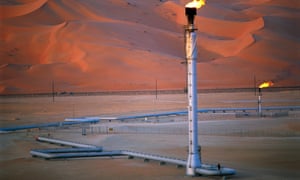
An oil field in Shaybah, Saudi Arabia

Saudi Arabia is planning to establish a $2tn (£1.4tn) sovereign wealth fund by selling off its state petroleum assets in preparation for a world beyond oil.
Greenpeace said it was a pivotal moment akin to Switzerland abandoning banking, but others claimed Riyadh had long wanted to diversify its economy and spread its wealth though it had failed to do so.
If the fund was built up to $2tn, it would be more than double Norway’s sovereign wealth fund, regarded as the largest in the world by assets.
The move was revealed by the country’s powerful deputy crown prince, Mohammad bin Salman, and would mean the desert kingdom using its public investment fund (PIF) to buy up strategic financial and industrial assets abroad.
Some will see the move as a highly symbolic shift away from fossil fuels for a country most associated in the public eye with oil, but critics question whether it is more about style than substance.
The sale of a first tranche of shares to private investors via an initial public offering (IPO) in the state-owned Saudi Aramco could start as soon as next year, with the eventual aim of being big enough to potentially buy some of the world’s largest companies such as Apple and Google’s parent, Alphabet. “IPOing Aramco and transferring its shares to PIF will technically make investments the source of Saudi government revenue, not oil,” the 30-year-old son of King Salman said in an interview with Bloomberg in Riyadh.
“What is left now is to diversify investments, so within 20 years we will be an economy or state that doesn’t depend mainly on oil.”
Saudi Arabia already has a PIF, but it remains small and currently has only 5% of its holdings abroad. Last July it spent $1.1bn on a 38% stake in South Korea’s Posco Engineering and signed off a $10bn deal in Russia.
Plans to allow foreign investors to buy shares in Saudi Aramco, the holder of the country’s oil wealth, were first revealed in January. Analysts have struggled to put a value on the entire business, but say it could be worth anything from $1tn to $10tn, the former being the combined value of Apple and Alphabet.

Bullet helps take TE Lawrence's Arab revolt story off the line of fire

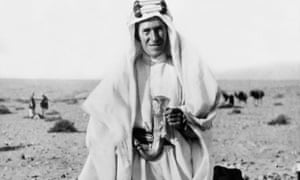
TE Lawrence

A tantalising find in the Arabian desert may help cast new light on TE Lawrence’s account of his part in the Arab revolt a hundred years ago.
Archaeologists who have spent a decade excavating dozens of sites associated with the 1916-18 conflict have uncovered a bullet that was probably fired by the man who became known as Lawrence of Arabia.
It was found during fieldwork at Halat Ammar, on the Saudi Arabia-Jordan border, site of an ambush that provided the famous train attack scenes in David Lean’s biopic starring Peter O’Toole.
Lawrence served as a military adviser with Arab forces fighting the Ottoman Turks, then allied with Germany. Experts from Bristol University, who have led the Great Arab Revolt Project, believe the find corroborates Lawrence’s own account in his war memoir, The Seven Pillars of Wisdom, and undermines the claims of some biographers that Lawrence over-embellished his stories.
Prof Nicholas Saunders said: “The bullet we found comes from a Colt automatic pistol, the type of gun known to be carried by Lawrence and almost certainly not used by any of the ambush’s other participants.”
Dr Neil Faulkner said: “Lawrence has something of a reputation as a teller of tall tales but this bullet – and the other archaeological evidence we unearthed during 10 years of fieldwork – indicates how reliable his account of the Arab revolt in Seven Pillars of Wisdom is.”
Both experts have books in the pipeline. Faulkner’s Lawrence of Arabia’s War, to be published by Yale University Press later this month, aims to rewrite the history of the maverick’s legendary military campaigns, looking too at the decline of the Ottoman Empire, the role of Bedouin tribes, growing Arab nationalism and western imperial ambition.
Saunders’ book, Desert Insurgency: Archaeology, TE Lawrence and the Great Arab Revolt, to be published by Oxford University Press next year, will detail how findings from investigations at armoured car raiding camps, Ottoman army campsites, desert fortifications, and train ambush sites have helped chart the origins of modern guerrilla warfare.

France accuses Syrian government of violating ceasefire

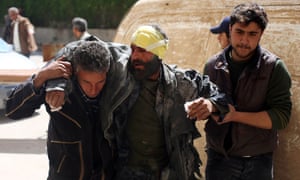
Syrians help a man, wounded during government airstrikes in Deir al-Asafir.

France has become the first major western power to directly accuse the Syrian government of violating the country’s ceasefire, saying airstrikes this week were intended to terrorise people and sap the international community’s efforts to find a political solution to the conflict.
Britain also produced a lengthy update on the state of the war, including numerous accounts of breaches of the partial ceasefire that came into force on 27 February.
A joint US-Russian monitoring operation based in Geneva is supposed to oversee ceasefire breaches, but there is no agreed mechanism for imposing sanctions on those responsible. The issue was discussed on Friday in Geneva, where peace talks are being held.
The condemnation from the French foreign ministry spokesman, Romain Nadal, came after airstrikes on the outskirts of Damascus reportedly killed 32 people, including civilians.
“France condemns the airstrikes carried out by the regime,” Nadal told reporters during a weekly briefing. “This attack, which deliberately targeted civilians, including children, shows that the regime is continuing its abuses and violating the truce.
“This abject act is designed to terrorise the Syrian people and sap efforts by the international community to find a political solution.”
The Syrian Observatory for Human Rights, a UK-based monitoring group, said earlier that Thursday’s airstrikes on the Deir al-Asafir district in south-eastern Damascus had mostly killed women and children.
The agreed ceasefire does not apply to attacks on areas held by Islamic State or the al-Nusra Front. Gareth Bayley, the UK’s Syria envoy, described the reports as deeply distressing, and said many civilians had also been killed in eastern Ghouta and Aleppo. 
The UK said 14 raids on Deir al-Asafir had been reported, including strikes on a school and mosque. A civil defence unit that attended the scene counted 25 bodies, while the local council put the death toll at 32.
The Syrian government claims the al-Nusra Front and Isis operate in the area where the airstrikes took place.
Diplomats will be concerned that the ceasefire breaches, and slow progress reported on extending humanitarian access, may mean the Syrian opposition will threaten not to return to the Geneva talks, which are due to resume on 9 April.
Senior opposition military figures have been meeting in Turkey this week to discuss the state of the ceasefire.
Speaking in interviews with the Russian press, Syria’s president, Bashar al-Assad, has suggested he might be willing to discuss a political transition.
The British foreign secretary, Phillip Hammond, however said on Thursday: “Bashar al-Assad talks about a unity government, by which he means bringing one or two handpicked, regime-friendly oppositionists into minor posts in the government. That is not sufficient.”
Britain and other powers which make up the international Syria support group believe a transitional government is needed to bring about a political settlement to the country’s civil war.

Turkey is no 'safe haven' for refugees – it shoots them at the border

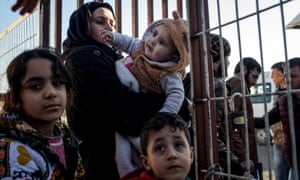
Syrian refugees wait at the Turkish border at Kilis, February 2016

It was beyond sad to read in the Times this week that Turkish border guards have allegedly shot dead Syrians trying to reach safety in Turkey. Sixteen refugees, including three children, have been killed trying to escape the battlegrounds of northern Syria in the past four months, according to the Syrian Observatory for Human Rights, a frequently cited watchdog.
It is shocking to think of people fleeing the combined atrocities of Islamic State and Bashar al-Assad being gunned down just as they make their bid for safety. But what is perhaps most shocking of all is that we observers are still shocked by this.
The shooting of Syrians on the border is not a new phenomenon. Refugees and rights groups have reported shootings of migrants on the Turkish-Syrian bordersince at least 2013. These abuses are well-documented, and the reports widely circulated. So why, in the months following a shady European deal that forces Turkey to shoulder the biggest burden of the refugee crisis, are we still so appalled when Turkey continues to use deadly violence to stop that burden getting any bigger?
A surge in border abuses is the logical result of a recent deal that sees the world’s richest continent (population 500 million) corral a single Middle Eastern country (population 80 million) into caring for more Syrian refugees than the rest of the world combined. We shouldn’t have expected any other outcome.
But sadly, some did. And Europe’s leaders – including David Cameron – apparently still do. Turkey is in the process of being designated by the EU as a “safe third country” for refugees – a sobriquet that gives Greece the right to send back almost all of those who land on its shores from Turkey.
Leaders, including Cameron, have justified this with the claim that refugees are safe from mortal danger in Turkey. Border shootings show this is not always strictly true, as do well-substantiated allegations that Turkey has illegally returned some Syrians and Afghans to the danger of their home countries, even after they had safely settled on Turkish soil. An alarming new report by Amnesty International, released today, alleges that in recent weeks large groups of Syrians have been deported back to Syria from southern Turkey, as officials there attempt to reduce their refugee burden. In Cameron’s favour, most refugees in Turkey are not at risk of death on a battlefield. But this is not what refugee advocates mean when they say that Turkey is an unsuitable place for refugees. Refugee rights extend far beyond the simple right to life: they include the right to education, to healthcare and to work. The point of giving people refugee status is to guarantee them all the opportunities that are extended to natural-born citizens of the country in which they now live.
For all its generosity in welcoming more refugees than any other country, Turkey does not offer such a guarantee. Take the right to work. EU politicians justified their deportation deal with the claim that a new Turkish law, introduced in January, has now given Syrians access to legal employment.
That isn’t actually the case. To qualify for a work permit, two things need to happen. First, a Syrian needs to have held a certain kind of ID card, known as akimlik, for six months – and not everyone can get one. Second, an applicant’s employer must give the Syrian a contract. Very few employers would ever want to do this, since the reason most Syrians find work on the black marker in the first place is precisely because they are illegal: they can be paid far less than the minimum wage, and work far longer than the legal daily limit. Many employers would rather fire a Syrian than pay him properly.
The first deportations of Syrians back to Turkey are set to begin on Monday. With little access to employment, the threat of deportation to Syria looming large and shootings on the border, we should be under no illusions that the deportees are being sent to safety.

Silencing Arab members of the Knesset would be a new low for Israeli democracy

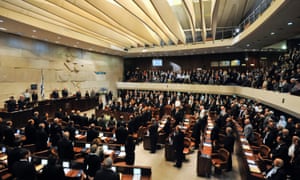
The opening of the Knesset, Jerusalem

What is left of Israeli democracy is today under attack. Over the past few years, the public and political atmosphere in the country has become more extreme. Nowhere is this more evident than in relations withIsrael’s Arab-Palestinian minority – around 20% of Israeli citizens – who have been the target of sustained and repeated attacks. The trend is most obvious in, but not limited to, legislation. Through pending and newly passed legislation, along with successful amendments to existing laws, attempts are being made to limit if not entirely suspend democracy. In the most recent assault on democratic rights, and in an attempt to undermine the Arab minority, the coalition in Israel’s parliament, the Knesset, proposedlegislation that would enable the suspension of elected representatives of the public – a move likely to disproportionately affect Arab MKs. The legislation stipulates that an MK can be suspended if 90 out of the 120 MKs support this motion. This legislation will allow elected officials to be relieved of their duties – not because they broke any law, but because their political agenda is found to be unacceptable. In its purest form, this represents tyranny of the majority and, if it passes, it will be a new nadir for Israeli democracy.
Supporters of the bill claim that this law is acceptable and standard practice in a democracy. However, Israel has veered far from acceptable norms of democratic discourse and practice. After nearly 50 years of occupation of the Palestinian territories and settlement expansion, the next logical target is an assault on Palestinian citizens within the recognised borders of Israel, while employing pseudo-democratic rhetoric as justification. Let’s be clear: this legislation attempts to not only shoot the message but also shoot the messenger. Supporters of this bill seek to eject Arab MKs in order to silence views they find intolerable. This is an affront not only to the MKs who may face removal from their positions, but also to those who voted. Such a move invalidates tens of thousands of legitimately cast votes and, as such, does not conform to the most basic principles of a democratic society.
If this proposal passes, it will make the right to be elected conditional on whatever the majority deems “good behaviour”. The threat of suspension will serve as a silencing tactic while also impeding MKs’ ability to faithfully fulfil the mandate they received from their voters. Until now, the Israeli supreme courthas served as a bulwark against some of the worst manifestations of this troubling trend, and has slowed the steady decline of Israeli democracy. Now, elected representatives seek to bypass the power of the courts through legislation such as this. Undoubtedly, this will represent a further erosion of the separation of powers.
In the rapidly shrinking democratic space in Israel, the Arab public needs to be assured that their will is reflected on the national stage. Their choice of representatives is reflective of their dreams and aspirations, their fears and struggles and their voice as a disenfranchised minority. These are basic democratic and citizenship rights that elected officials are threatening to strip from other MKs and their constituencies.
Against these attacks on democratic values, we at the Joint List political allianceare committed to the values of human and civil rights and will continue to work for a brighter future for both peoples, even as others pursue this anti-democratic campaign.

Retired lawyer sues Israeli airline after she was asked to move seat

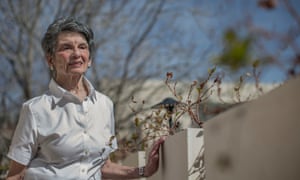
Renee Rabinowitz

A retired lawyer who fled the Nazis as a child is suing the Israeli national airline El Al for alleged discrimination after being asked to move on a plane when an ultra-Orthodox Jew objected to sitting next to a woman.
Renee Rabinowitz, 81, is being supported by the Israel Religious Action Center, which has campaigned against ultra-Orthodox efforts to enforce the segregation of men and women and to have images of women removed from public hoardings.
Almost 7,500 emails have been sent by members of the public to El Al objecting to requests made to women passengers to change seats.
Rabinowitz, a Jew who attends synagogue and keeps a kosher home, told the Guardian: “The man had no other reason to complain than my gender – and that’s unlawful discrimination. It’s no different than if a person of another religion had said: ‘I don’t want to sit next to a Jew.’ And I don’t believe El Al would move a person in those circumstance.”
On 2 December last year, Rabinowitz settled into her business class seat on an El Al flight from New York to Tel Aviv following a visit to the US to see family. Her seat was one of a pair separated by a screen.
Shortly before the plane doors closed, a passenger who had been allocated the window seat next to Rabinowitz boarded. The middle-aged man, who was wearing ultra-Orthodox garb, called a flight attendant and spoke to him in Hebrew.
Rabinowitz said the flight attendant then offered Rabinowitz what he described as a better seat, one of the central row of three nearer the first class cabin. “I didn’t understand. It wasn’t a better seat,” she said.

UK urged to give asylum to 100 women who fled Isis captivity in Iraq

A young Yazidi woman from Iraq

Campaigners have called on the British government to grant asylum to at least 100 women and girls who escaped after being kidnapped and raped by Islamic State militants in northern Iraq.
Isis fighters have abducted thousands of girls from ethnic minority communities in northern Iraq and forced them into sexual slavery since overrunning the area in 2014.
Although many hundreds have managed to escape or have been rescued, according to Kurdish regional authorities, they are often deeply traumatised and face uncertain futures on returning to their communities.
Jacqueline Isaac, a lawyer and campaigner who works with escapees in refugee camps in northern Iraq, has called on Britain and other western countries to offer asylum and psychological support to 100 girls. “We’re not talking about letting in thousands of refugees, we’re talking about 100 young girls that need care that they may not be able to get there [in northern Iraq] because of lack of resources and the culture,” she said.
“It’s very hard for a girl there to get what she needs and thrive because of what she has been through. Even though the Kurdistan regional government and the locals are doing a great job to try to support them, there is still that culture that is ingrained in the society that says if you have been raped or lost your virginity, you don’t have as much value.”
Isaac said the majority of the girls were Yazidis, a religious minority that Isis had targeted in northern Iraq, but added that Christian, Shia Muslim and Turkmen girls had also been enslaved.
A UN report published in January said up to 3,500 people were currently being held as slaves in Isis-controlled territory in Iraq, the majority of them women and children. At least 18,000 civilians had been killed and more than 3.2 million displaced since January 2014, it said, describing the violence against civilians as “staggering”. Germany has taken in at least 1,100 formerly enslaved young women from northern Iraq as part of a project that offers them specialised psychological support when they arrive, Agence France-Presse reported last month. Prof Jan Ilhan Kizilhan, a German doctor working in Baden-Württemberg state, which financed the programme, told the agency he believed that 1,200 other women would benefit from similar programmes, not counting the numbers still in captivity.
Isaac told the Guardian that she had interviewed more than 100 escapees in Iraqand Germany about their experiences, ranging in age from nine to their early 20s. She said many had described witnessing family members being killed before they were bussed to locations where they had been categorised according to age, marital status and perceived attractiveness, before being allocated to different groups of fighters.
Isaac, an Egyptian-American who is the vice-president of humanitarian organisation Roads of Success, gave evidence last year to the US Congress on abuses against women in Iraq. The Republican-dominated House of Representatives voted unanimously in March to declare that Isis atrocities against Yazidis, Christians and other minority groups amounted to genocide.
This was followed by the US secretary of state, John Kerry, who said the group was “genocidal by self-proclamation, by ideology and by actions, in what it says, in what believes and in what it does”.
A spokesman for the Home Office said the British government was “at the forefront” of the humanitarian response to the crisis and had pledged £2.3bn to help refugees in the Middle East. He added that it was a longstanding government position that someone could not apply for asylum from outside the UK.