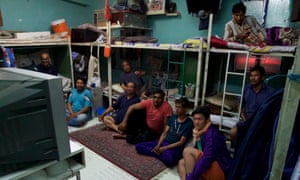
Balfour Beatty and Interserve, two of the UK’s largest construction companies, have been accused of a raft of labour abuses by migrant workers employed on large-scale projects operated by companies that the firms co-own in Qatar.
Labourers on construction sites operated by BK Gulf, co-owned by Balfour Beatty, and Gulf Contracting Company (GCC), co-owned by Interserve, allege that they have been exploited and mistreated by labour supply companies hired by the firms to furnish construction sites in Doha with cheap manual workers.
The alleged abuses include erratic or reduced payment of wages, passport confiscation, workers entering employment with high levels of debt bondage, and pay levels below those agreed when workers were recruited in their home countries. The workers spoke of a culture of fear and intimidation, with threats of arrest or deportation if they stepped out of line. The Guardian spoke to more than a dozen migrant workers, all of whom requested to remain anonymous due to fears of losing their jobs.
One labourer, employed by a supply company but working for GCC, which is 49% owned by Interserve, said he repeatedly asked his employer to let him leave Qatar after his salary was cut by 20%, but he was forced to stay. “I went to the [manager] and said, ‘I will give you the money for my plane ticket. Send me home.’ But he said, ‘Until and unless the contract finishes … you can’t go.’”
Labourers employed by labour supply companies but working for BK Gulf at Qatar’s national museum said they were earning a much lower salary than promised when they were recruited in Nepal. Some claimed their basic salary was only £135 a month. They said their wages were cut if they missed work due to illness, and they had to pay their own medical fees above £20.
“They withhold the first two months of salary … they do this to everyone,” said one worker from Nepal. “When I came here I was told by the agent that I could earn around 1,700 rials [£330] a month [with overtime]. If I had known I would only get 800 rials, and 200 rials for food, I definitely wouldn’t have come.”
Labourers working for BK Gulf at the museum praised safety management on the site, and two workers employed directly by GCC, building a office tower in Lusail City, said they were happy with the conditions of their labour camp. However,despite widely reported problems with the abuse and exploitation of migrant workers in Qatar and elsewhere in the Gulf, these new allegations suggest that neither British firm has taken the necessary precautions to ensure supply chains are free of labour abuses.
Ray Jureidini, a professor of migration, human rights and ethics at the Research Center for Islamic Legislation and Ethics in Qatar, said: “Companies that use these workers contract only with the labour supply companies, not the workers. The workers are not on their books and they don’t look into the company they have contracted with. They don’t look at how workers were recruited, their salary or living conditions … whether they are trafficking victims. I call it the corporate veil.”
The Qatari authorities have launched initiatives to improve conditions for migrant workers, including efforts to improve accommodation, such as building a flagship Labour City outside the capital.

No comments:
Post a Comment