Russian troops in Syria could end up helping Isis, report claims
The deployment of Russian troops in Syria
could end up helping Islamic State as they have been sent to areas
where they are most likely to fight other groups opposed to Isis,
according to a new report.
The Royal United Services Institute (Rusi) report
comes ahead of a US-Russian summit meeting at the UN on Monday, when
Barack Obama will question Vladimir Putin on the intention behind
Russia’s deepening military involvement in Syria, according to US
officials.
The Iranian president, Hassan Rouhani – also in New York for the UN
general assembly meeting – rejected suggestions that his country was
operating in concert with Russia against Isis. “I do not see a coalition
between Iran and Russia on fighting terrorism in Syria,” Rouhani said.
The Rusi report, titled Inherently Unresolved, assesses the global
effort to counter the spread of Isis, and warns that Iraq and Syria may
not survive as unitary states. It includes a section on Russian aims,
particularly those underpinning Putin’s despatch this month of warplanes and troops to Tartus and Latakia in support of Bashar al-Assad’s regime.
Igor Sutyagin, a Russian strategic analyst, said there was an air
regiment at Latakia with 28 planes, a battalion of motorised infantry
and military engineers as well as a marine battalion at the naval base
in Tartus.
The deployment, Sutyagin said, “underlines the contradictions of the
Kremlin’s policy”, because the troops were in areas where Isis is not
present.
“In this way, Russian troops are backing Assad in the fight against
groups such as Jabhat al-Nusra and Ahrar al-Sham, which are themselves
opposed to Isis. If Russian troops do eventually join combat, therefore,
they would also – technically – be assisting Isis,” Sutyagin argued.
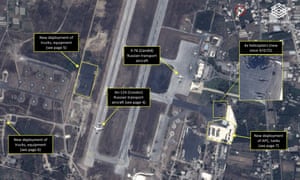
Satellite image from last week shows Russian aircraft and ground
vehicles at air base in Latakia, Syria. Annotations provided by
GeoNorth, AllSource Analysis, Airbus. Photograph: GeoNorth, AllSource
Analysis, Airbus via AP
The report says the Russian deployment should not therefore be seen
as a change of policy towards fighting Isis directly, but a largely
political move designed to save Assad and consolidate Russia’s hold over
its naval base at Tartus and its newly built air base in Latakia, while
currying favour with the west and the Gulf Arab states who are
themselves reluctant to fight Isis on the ground.
“Indeed, the Kremlin may well be hoping that the west will show its
appreciation by lifting the sanctions imposed in response to the
situation in Ukraine,” Sutyagin said.
The tensions hanging over the Obama-Putin meeting on Monday were
highlighted by discord between Washington and Moscow in describing the
summit. US officials said it had been requested by Putin. A Russian
spokesman insisted it was Obama who asked to meet. The White House said
the meeting would address both the conflicts in Ukraine and Syria. The
Kremlin said Ukraine would only be raised “if there was time”.
Celeste Wallander, the White House National Security Council’s senior
director for Russia, said that Obama would press Putin on his
objectives in Syria.
“There’s a lot of talk, and now it’s time for clarity and for Russia
to come clear – come clean and come clear on just exactly how it
proposes to be a constructive contributor to what is already an ongoing
multi-nation coalition,” Wallander told journalists.
Putin meanwhile told CBS News:
“There is no other solution to the Syrian crisis than strengthening the
effective government structures and rendering them help in fighting
terrorism. But at the same time, urging them to engage in positive
dialogue with the rational opposition and conduct reform.”
The White House argues that the Russian strategy of entrenching Assad
will only serve to deepen the roots of extremism in Syria. Ben Rhodes, a
White House spokesman, said that at the UN meeting “the president will
have the opportunity to make clear to President Putin that we share the
determination to counter Isil [Isis], that we welcome constructive
contributions to counter Isil. But at the same time, we believe that one
of the principal motivating factors for people who are fighting with
Isil is the Assad regime.”
The Rusi report said that it would be “perfectly feasible” to defeat
Isis if Turkey and Iran were also engaged in the search for a regional
solution. It advised US policymakers to “not give up on the possibility
of maintaining the unity of Iraq and Syria, but not be beholden or
obsessed with this idea either”.
“If the US could ‘father’ two brand-new states in the Balkans during
the 1990s, there is no reason why Washington should not tolerate at
least the informal emergence of new states in the Middle East,” the
report argued.

No comments:
Post a Comment