No 10 plans limited Syria strikes and push for transition of power
Downing Street is drawing up a new strategy for Syria that would
involve limited military strikes against the “controlling brains” of the
Islamic State and a renewed diplomatic push that could see Bashar al-Assad remain president for a transitional period of six months.
In a sign of No 10’s determination to avoid another Commons defeat on Syria,
ministers are arguing that military action would be narrowly defined to
remove a terrorist threat with the added benefit of strengthening
Iraq’s democratically elected government.
David Cameron highlighted the government’s belief that the time is
fast approaching for Britain to extend its airstrikes against Isis
targets from Iraq into Syria when he said “hard military force” would be
necessary.
The prime minister said he would seek parliamentary approval before
escalating Britain’s involvement. He told MPs: “We have to be part of
the international alliance that says we need an approach in Syria which
will mean we have a government that can look after its people. Assad has
to go, Isil has to go. Some of that will require not just spending
money, not just aid, not just diplomacy but it will on occasion require
hard military force.”
The government has faced intense scrutiny over its strategy in Syria
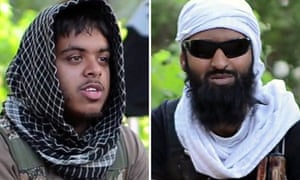
after Cameron announced to MPs on Monday that an RAF Reaper drone had killed two British Isis jihadis last month. Reyaad Khan and Ruhul Amin
were killed on 21 August near Raqqa. Junaid Hussain, another Briton,
was killed in a US airstrike on 24 August as part of a joint operation.
Reyaad Khan and Ruhul Amin, who were targeted and killed in RAF drone strikes in Syria on 21 August. Photograph: YouTube/PA
Downing Street said the strikes were designed to foil terror plots
planned by Khan and Hussain and did not mark wider British involvement
in coalition airstrikes against Isis targets in Syria, which would
require parliamentary approval. Cameron said he was free to act without a
vote in parliament in the event of such an emergency.
Philip Hammond, the foreign secretary, made clear on Wednesday
that the government would like to widen its involvement in the
airstrikes over Syria. But the government is making clear that it has
three clear goals designed to win support in a possible parliamentary
vote, which will become more challenging if Jeremy Corbyn is elected
Labour leader on Saturday.
The three goals are:
Military – the defeat of Islamic State.
Political – strengthening the Iraqi government.
Diplomatic – helping to lead a new initiative in Syria, with the
blessing of Russia and China, that would see the installation of a
government of national unity. As a way of getting Assad’s two great
patrons, Russia and Iran, on board, Britain and other western powers
would agree to a transitional period of up to six months in which Assad
would remain in office. But his security apparatus would be shut down.
Hammond repeatedly stressed to MPs on the Commons foreign affairs
select committee that any planned British involvement in military action
in Syria would be limited to disrupting Isis command and control in
Raqqa. The aim would not be to change the balance of power in the
deadlocked four-year civil war, the government’s purpose when it last
asked parliament to endorse military action.
He said there was no intention for Britain to get “involved in
complex three-way fights in north-west Syria where regime forces and
other forces are involved. What we are looking at are Isil command and
control nodes around Raqqa from which it has supply lines running north.
We are unable to attack those command and control nodes and supply
lines. The military logic drives us to believe there could be utility to
have greater freedom.”
The foreign secretary added: “The objective is to defeat Isil and
that means we have to get to the controlling brains. At the moment we
are attacking an enemy in Iraq and if we formed the judgment that this
air-based campaign was more efficacious if we attacked Isil in Syria, we
would ask parliament.
“The logic of extending our mandate to cover Isil targets in Syria
would be very clearly a logic in support of the mandate we have in Iraq
for the collective defence of that country.”
On the diplomatic front, Hammond said Britain was prepared to be
“pragmatic” in discussing a transitional plan lasting months for Assad’s
removal. “We are not saying Assad and all his cronies have to go on day
one,” he said.
The foreign secretary said there was no sign at present that either
Iran or Russia was prepared to abandon Assad, but argued there was no
military solution that would lead to victory either for Assad or his
opponents.
He said Britain and its allies would not accept any plan that would
entrench Assad’s position in power. “The international community cannot,
in my view, facilitate and oversee a set of elections in which somebody
guilty of crimes on the scale that Assad has committed is able to run
for office. That has to be clear. He cannot be part of Syria’s future.”
Cameron faced pressure from Harriet Harman, the acting Labour leader,
to put a figure on the number of people Britain was prepared to take
from refugee camps in countries neighbouring Syria. The prime minister
indicated to MPs that the government was keen to accelerate the process.
On Friday the home secretary, Theresa May, and the communities
secretary, Greg Clark, will chair the first meeting of a new committee
to oversee the admission of refugees.
Cameron told Harman in the Commons: “It is one thing to give a
commitment to a number, whether it is the 20,000 that I think is right
or something else. It is another thing to make sure that we can find
these people, get them here and give them a warm welcome. I hope that
the whole country can now come together in making sure that we deliver
this effort properly.”
The prime minister has said the government will place a particular
emphasis on admitting orphaned children. But he indicated that the
government would limit the number of children in two other categories.
Britain will refrain from admitting unaccompanied children from
Syria’s neighbouring camps to avoid trafficking and to stop parents from
later using their children to settle in the UK. Cameron also indicated
that Britain would not accept refugee children who had already made it
to Europe.
He told MPs: “We will go on listening to Save the Children, which has
done excellent work. A number of other expert organisations warn about
the dangers of taking children further from their parents. The overall
point I would make is that those who have already arrived in Europe are
at least safe. If we can help the ones in the refugee camps – the ones
in Lebanon and Jordan – it will discourage more people from making the
perilous journey.”
Gordon Brown has said in an article written for the Guardian
that all countries accepting refugees should place a particular
emphasis on helping children. The former prime minister writes:
“Eglantyne Jebb, who started Save the Children to help child refugees in
the wake of the first world war, said the only international language
the world understands is the cry of a child. But from her own experience
of visiting neglected orphans, the author JK Rowling feared that ‘no
one is easier to silence than a child’. In the next few weeks we will
find out whether optimism will win through and whether the voices of
millions of children will finally be heard.”

No comments:
Post a Comment