Theresa Halsa was only 18 when she hijacked flight 571. Was she ready to die? “Of course. Everybody involved in the operation was ready to die,” she says from her home in Amman, Jordan.
Halsa is the only survivor of the four Black September hijackers who seized the Sabena airlines Boeing 707 20 minutes into its flight from Vienna to Tel Aviv on 8 May 1972. After forcing the plane’s British captain Reginald Levy to land at Lod (now Ben Gurion) airport, the hijackers demanded the release from Israeli jails of 315 Palestinians convicted of terrorism offences, and threatened to blow up the plane with its passengers if their demands weren’t met.
“They called us terrorists, but we weren’t. The real terrorists were the Israelis who threw the Palestinian people off their land,” Halsa says.
Halsa is talking to me because a new Israeli docudrama about the hijacking,Sabena Hijacking – My Version, premieres at the Jewish film festival in London on Saturday. It mixes interviews from those who took part on both sides with archival footage and dramatisations.
During the 30 hours in which Halsa and her accomplices held 90 passengers and 10 crew at gunpoint, she recalls, she expected to die. “I thought I would be shot by Israeli soldiers. Or we were going to blow up the plane if our demands weren’t met. I was ready to die because I wanted to make the Europeans and Americans realise that there was a Palestinian people and that they had been treated unjustly by the Israelis.”
The Black September group was named in commemoration of the deaths and expulsions of thousands of Palestinians in Jordan in September 1970, but became famous mostly for its attacks on Israeli targets, notably the murders of 11 of Israel’s athletes in Munich during the summer Olympics a few weeks after the flight 571 hijacking.
How did the Israeli-born Arab nurse become a hijacker? “It’s a long story. Difficult to talk about on the phone with my bad English.” But she tries. Halsa came from a family of Arab Christians and graduated from an Israeli school in Acre. She says she wanted to join the Palestinian Liberation Organisation (PLO) because of growing hostility of Jews toward Arabs in and outside of Israel.
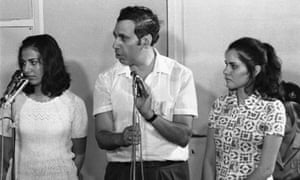
Six months before the hijacking, she crossed the Israeli-Lebanese border and took part in training at a camp near Beirut, learning how to use a handgun, explosion belts and grenades. Early in 1972, she and three other Palestinian members of the Black September group were chosen to hijack flight 571. The four – Ali Taha Abu Snina, Abed al-Aziz Atrash, Rima Tannous and Halsa – only met the day before they seized flight 571, and posed as two young couples. They flew from Lebanon on forged passports to Rome, where they were provided with forged Italian passports, before flying to Frankfurt, then Brussels, where they boarded flight 571 with yet more forged passports (this time Israeli ones), on the first stage of its journey to Israel.
Twenty minutes after takeoff from Vienna, they seized control of the plane. At that point, the captain laconically remarked to passengers over the PA: “As you can see, we have friends aboard.” The four men and women were armed with two handguns, two hand grenades and two explosion belts.
The hijackers told Levy to fly to Lod airport near Tel Aviv. Once on the runway, they issued their demands to ground control staff. Soon after, the defence minister Moshe Dayan and the transport minister (and future PM and president)Shimon Peres arrived to oversee negotiations.
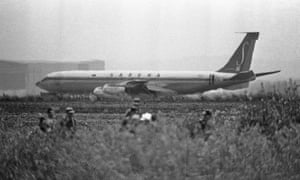
The Israelis used the negotiations to play for time, pretending to accept the demands, while 16 commandos from the special forces unit Sayeret Matkal prepared to storm the plane. Twenty-four hours after the plane had landed, Operation Isotope began. All the Israeli commandos involved were wearing white overalls to dupe the hijackers into believing they were technicians who had come to fix the plane’s hydraulic system.
Operation Isotope was all the more remarkable for the fact that two other future Israeli prime ministers – Ehud Barak and Binyamin Netanyahu – were among the commandos. Hence aheadline in the Times of Israel recently: “When the prime ministers took down the hijackers.”In the ensuing gun battle, the two male hijackers were shot dead and the two women captured. Three passengers were injured and one, 22-year-old Miriam Anderson, later died in hospital.
Operation Isotope has long been celebrated in Israel as showing the cunning and resolve of its politicians and armed forces against terrorist threats. When prime minister Netanyahu spoke at the film’s premiere in Jerusalem in September, he recalled that in the 1970s, “terrorists were like preying animals, grabbing planes, kidnapping passengers and threatening to kill them and sometimes doing so”.The “most important lesson” of this era for Israel, he said, “is that it was not merely sophisticated military expertise but our determination and our daring against those who threaten us that curbed this particular form of terrorism”.
Does Halsa have any regrets about what she did? “Yes. I wish we had blown up the plane.” Why? “I think that European and Americans are looking at Israel with two eyes. With the Arab people, they look just with one eye.”
Halsa was sentenced to 220 years in jail for her part in the hijacking of Sabena flight 571 – a life sentence for each of the hostages on the flight. “The Israeli authorities wanted to break us, to break our character, to break the spirit of the Palestinian people, by giving us these long sentences, ” Halsa says. “But they didn’t.”
The film is, among other things, a window into another world. “In those days,” says the director, Nati Dinnar, “people would hijack planes because they believed they could get what they want.” Indeed, two of Halsa’s accomplices had successfully hijacked planes before. One had participated in the hijacking of an El Al plane to Algeria in 1968 and a Lufthansa plane to Aden, Yemen, in 1972, while another had been involved in PLO hijackings in Jordan.In November 1983, as part of the prisoner exchange between the PLO and Israel after the first Lebanese war of 1982, she was released and now lives in Jordan. “I didn’t choose to go out [of Israel],” says Halsa. “It was imposed on me. Now I’m very happy in Jordan.” Now in her mid-60s, she is married, has two sons and a daughter and is a care worker with disabled people.
“Now nobody hijacks planes like that. Instead, they fly them into the twin towers or blow them up over the Sinai,” says Dinnar. “Everybody knows that negotiators are not going to give in, as they did in the past, but stall for time. So hijacking doesn’t work.”
Dinnar’s docudrama was given more detail and authenticity by the discovery of the late Levy’s tape-recorded account of the hijacking, some of which is played during the film. But what Sabena even more poignantly dramatises is the quiet heroism of the London-born Jew, who received the Distinguished Flying Cross for his wartime service for the Royal Air Force, during the 30-hour ordeal, which coincided with his 50th birthday. “He functions so calmly,” says Dinnar. “One minute he was about to be killed by the hijackers when he tries to grab their pistol, but a few hours later he managed to convince them to let him go and speak to the Israelis.”
Levy was astute enough not to disclose to the hijackers that his wife was one of the passengers. He had brought her on the flight for a romantic meal to celebrate his birthday in Tel Aviv, planning to return the following morning. In one fine scene, Levy is allowed to leave his cockpit to visit his crew and passengers in the cabin. He speaks to his wife as if she were a passenger: “I am so sorry,” he says, “for the terrible ordeal I have put you through.”

No comments:
Post a Comment